



cGMP Plasmid DNA Manufacturing: Process, Scale and CDMO Capabilities
Written by Dr Vanessa Kee, Global Marketing Lead
Table of contents
Plasmid DNA is the starting material behind some of the most active areas of modern biotech: the source of DNA templates for mRNA synthesis, a key starting material for AAV and lentiviral vector production, a DNA vaccine in its own right, and a DNA vector for delivery of CRISPR gene-editing components. Its purity, supercoiled content, and other critical quality attributes can influence downstream manufacturing performance and product quality.
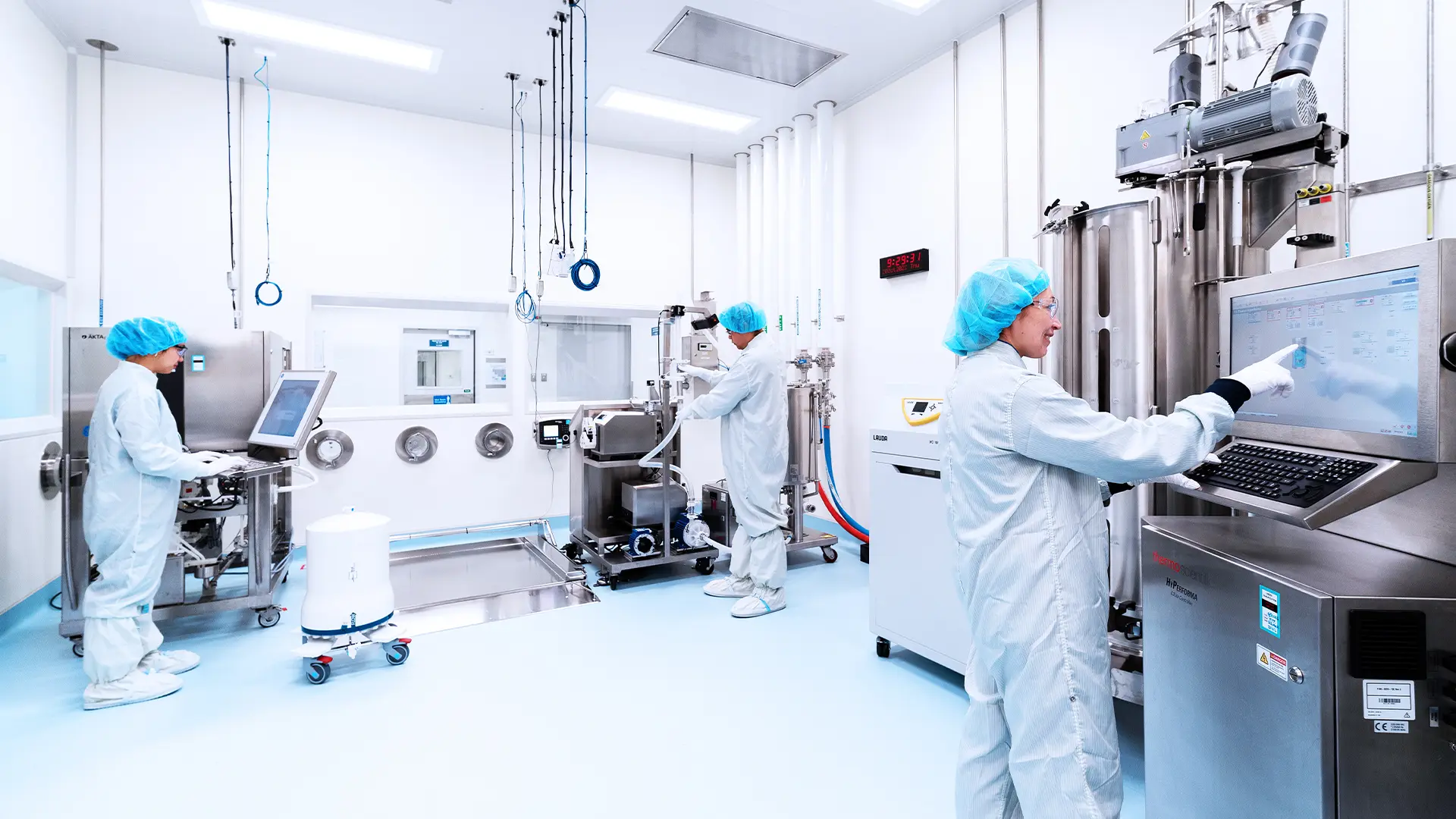
As a pDNA manufacturing CDMO, BioCina provides cGMP plasmid DNA manufacturing within its dedicated Adelaide Nucleic Acid Suite, using the same E. coli fermentation platform, fermentation suites, and downstream equipment used across BioCina's wider biologics portfolio. GMP-grade plasmid has been manufactured and released for client programs, including experience with minicircle DNA for a CAR T-cell therapy application and clinical trial material for a DNA-based vaccine.
Explore pDNA Capabilities
Discuss Your pDNA Program
Plasmid DNA Development and Manufacturing Platform
Sourcing plasmid DNA from a separate specialist supplier often introduces technology-transfer activities, comparability considerations, scheduling dependencies, and capacity constraints ahead of downstream manufacturing, whether the program is mRNA synthesis, viral vector production, or a DNA vaccine. Delays or changes in template quality or specifications can affect downstream manufacturing and timelines. BioCina's available pDNA manufacturing capacity and agile, single-site model help reduce supply-chain dependencies, lead-time uncertainty, and the capacity constraints associated with external pDNA sourcing.
BioCina’s pDNA manufacturing CDMO capabilities include purified circular plasmid DNA supply and plasmid linearization to generate the DNA template for in vitro transcription, supporting applications that require a plasmid DNA template for mRNA production. This capability uses the same fermentation platform as BioCina's microbial protein programs and, for mRNA or gene therapy programs already running through BioCina, removes a supplier interface while reducing the comparability and transfer activities associated with an external pDNA supplier. For standalone pDNA requirements, manufacturing takes place within BioCina's dedicated Nucleic Acid Suite, a facility built specifically for nucleic acid work.
From Plasmid Construct to cGMP Supply
BioCina's plasmid process development works from a client's sequence or existing construct, supporting optimization for plasmid copy number, structural stability, and suitability for the intended manufacturing and regulatory pathway.
Construct Optimization
BioCina's plasmid process development works from a client's sequence or existing construct, supporting optimization for plasmid copy number, structural stability, and suitability for the intended manufacturing and regulatory pathway.
Cell Banking and Host Strain Development
Master and working cell banks are established from the optimized E. coli strain, characterized and documented to support IND, CTN, and commercial filings.
Upstream Fermentation
High-cell-density fed-batch microbial fermentation is optimized to balance plasmid productivity, copy number, plasmid stability, and biomass yield at each scale. Cells are then harvested and concentrated.
Plasmid Purification
Downstream, a process incorporating continuous alkaline lysis, clarification, and chromatographic plasmid purification, including CIM monolith chromatography, is developed to achieve the required supercoiled fraction and remove residual host cell protein, RNA, and genomic DNA. The supercoiled isoform is generally preferred for many pDNA applications, since plasmid topology can influence transfection and gene expression performance, making preservation of the supercoiled fraction an important purification target rather than a secondary consideration. [1] [2]
Linearization and Final Processing
Tangential flow filtration and final filtration complete the downstream process, ahead of fill for programs requiring intact plasmid, or ahead of plasmid linearization and transfer to mRNA synthesis for template applications.
Release Testing
The majority of pDNA release testing, including DNA concentration, purity, identity and integrity, plasmid isoform distribution, residual host cell protein, residual host cell RNA, residual genomic DNA, endotoxin, bioburden, and pH, is performed in-house. Where specialist analytical testing is required, BioCina works with qualified external laboratories. Keeping the majority of release testing in-house supports streamlined sample handling, traceability, and efficient batch disposition.
Plasmid DNA Production Scales & Technical Specs
BioCina's pDNA platform spans the same process development through cGMP manufacturing continuum used across its microbial biologics portfolio, supporting continuity from process development through cGMP manufacturing without requiring a change in manufacturing partner as the program scales.
| Stage | Equipment | Working Volume | Plasmid Yield |
|---|---|---|---|
| Process Development | 2 L fermenters, 8 parallel units | 400 mL to 1 L | 50 to 200 mg |
| Scale-Up | 20 L fermenter | 10 to 20 L | 500 mg to 1 g |
| cGMP Manufacturing | 435 L single-use bioreactor (SUB) | 65 to 300 L | Greater than 1 g per batch |
| cGMP Manufacturing | 750 L stainless steel fermenter | 200 to 500 L | 5+ g per batch |
Both circular and linearized plasmid-derived DNA templates are supported, with purified circular plasmid providing the starting material for applications requiring intact pDNA and, where required, undergoing plasmid linearization to generate the DNA template for in vitro transcription. [2]
Plasmid DNA Applications
BioCina manufactures plasmid DNA for use across five core application areas, including as an mRNA template, as a starting material for AAV and lentiviral vector production, as an active pharmaceutical ingredient for DNA vaccines, and as a delivery construct for gene-editing programs.
mRNA Template Supply
Linearized plasmid DNA serves as the template for in vitro transcription of mRNA drug substance, making template quality and complete linearization important considerations for mRNA yield and integrity. Plasmid manufacturing and linearization take place within the same Adelaide Nucleic Acid Suite used for mRNA synthesis.
Plasmids for AAV Production
AAV vector production typically uses multiple plasmid components, including a transfer plasmid containing the gene of interest between ITRs, a Rep/Cap plasmid, and, in conventional helper-free systems, a helper plasmid. ITR integrity is an important quality consideration for AAV transfer plasmids. Both Rep/Cap and transfer plasmid manufacturing are available for AAV production programs.
Plasmids for Lentiviral Vector Production
Lentiviral vector systems distribute functions such as transfer, packaging, and envelope across separate plasmids, helping reduce the risk of generating replication-competent lentivirus. Transfer, packaging, and envelope plasmid manufacturing are all available for these multi-plasmid systems.
DNA Vaccines
Unlike the other applications, a DNA vaccine uses plasmid DNA as the active pharmaceutical ingredient itself, administered as the vaccine product rather than used as a manufacturing intermediate. This is delivered experience rather than theoretical capability: antigen-encoding plasmid DNA has been manufactured for a DNA vaccine program, including clinical trial material supplied to a client.
CRISPR and Gene-Editing Programs
Plasmid DNA is one of several delivery formats used in CRISPR-based gene editing, with plasmid constructs used to express Cas9, base editors, prime editors, and/or guide RNA components depending on the editing strategy. Non-viral plasmid delivery constructs for these programs are part of the platform's standard offering.
Expert Microbial Operations & Regulatory Excellence
GMP pDNA manufacturing at BioCina's Adelaide site is backed by an active TGA manufacturing licence for clinical and commercial biological drug substance manufacturing. BioCina's manufacturing operations and quality systems have been inspected by the US FDA, with the inspection completed with zero critical observations, and BioCina's quality and manufacturing systems are aligned with the principles of ICH Q8, Q9, Q10, and Q11.
The majority of pDNA release testing, including DNA concentration, purity, identity and integrity, plasmid isoform distribution, residual host cell protein, residual host cell RNA, residual genomic DNA, endotoxin, bioburden, and pH, is performed in-house. BioCina also has access to specialist analytical capabilities to support testing requirements as needed. Keeping the majority of release testing in-house supports streamlined sample handling, traceability, and faster batch disposition.
This pDNA platform draws on more than 30 years of E. coli-based fermentation experience at Adelaide, the same host organism, fermentation platform, and downstream equipment used across BioCina's microbial biologics programs.
Integrate your pDNA program to BioCina's mRNA Manufacturing
BioCina's pDNA template manufacturing produces linearized pDNA for mRNA in vitro transcription within the same Adelaide Nucleic Acid Suite, under the same quality system, reducing inter-site material transfer and the associated technical-transfer and comparability activities involved in sourcing template from a separate supplier. The same fermentation platform also supports BioCina's microbial protein programs, and drug substance manufactured in Adelaide connects to BioCina's sterile fill-finish operations in Perth.
FAQs

Ready to Secure Your cGMP Plasmid DNA Supply?
As a pDNA manufacturing CDMO, BioCina produces cGMP plasmid DNA from preclinical quantities through commercial gram-scale batches, with a direct pathway to mRNA synthesis and BioCina's broader biologics manufacturing platform on a single Adelaide site.
Request a Site Tour