


Demand for integrated mRNA LNP manufacturing is accelerating as programs advance from early development into clinical supply, with lipid nanoparticle delivery systems emerging as the platform of choice across vaccines and gene therapy. Sponsors need more than just capacity from their CDMO partner; they need integration, scientific depth, and the GMP infrastructure to move from sequence to clinic without disruption.
As a purpose-built CDMO for mRNA programs, BioCina delivers all three: end-to-end integration across a single-company platform for GMP mRNA manufacturing, spanning plasmid DNA production through in vitro transcription, mRNA purification, LNP encapsulation, and sterile fill-finish, all at GMP standard. BioCina also has scientific depth built on decades of complex biologics manufacturing and a regulatory track record spanning global regulatory agencies including the FDA, EMA and TGA.
Access the resource here:
What is mRNA LNP Manufacturing?
mRNA LNP manufacturing combines two distinct processes: the synthesis of messenger RNA followed by its encapsulation within lipid nanoparticles for delivery into the body. mRNA is produced through in vitro transcription (IVT) from a plasmid DNA template, purified to remove process-related impurities, then encapsulated using precision microfluidic mixing to produce a drug substance ready for formulation and fill-finish. Because mRNA is inherently unstable and sensitive to temperature and handling conditions, each step must be tightly controlled to preserve integrity, potency and safety.
Why an Integrated CDMO Matters for RNA Therapeutics
mRNA-LNP programs are among the most technically demanding to manufacture. Each intermediate — plasmid DNA, mRNA, and LNP-encapsulated product — is sensitive to process variability and cold-chain conditions. Fragmented supply chains introduce unnecessary freeze-thaw cycles, inter-site shipping risk, and handoff delays that compound quality and timeline risk.
An integrated CDMO addresses this directly: drug substance development and manufacture is consolidated at the biologics facility, with sterile fill-finish completed at BioCina’s fill-finish facility, coordinated by a single project team. This removes third-party handoffs, reduces degradation risk, and gives sponsors consistent oversight from IVT through to final drug product.
BioCina's End-to-End mRNA LNP Platform
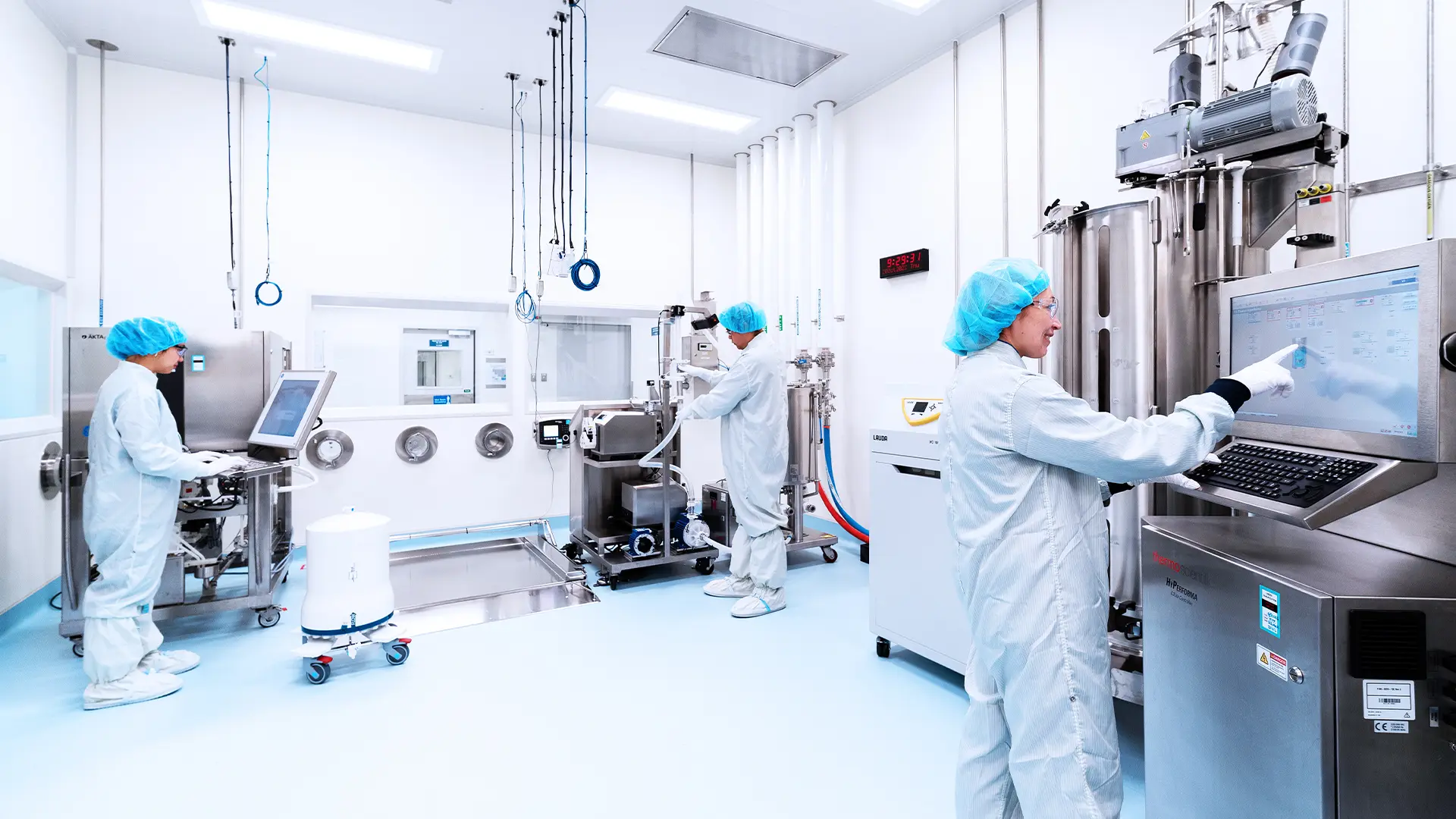
BioCina’s biologics facility covers GMP plasmid DNA production, in vitro transcription, mRNA purification, LNP encapsulation, and bulk fill of encapsulated mRNA. Aseptic fill-finish of the final drug product is completed at BioCina’s fill-finish facility. The biologics facility houses dedicated Grade C (ISO 7) mRNA-LNP manufacturing suites equipped with a Cytiva FlexFactory single-use equipment train, targeting operational readiness in 2026. [1]
The platform is supported by an ongoing research collaboration with the University of Adelaide, exploring LNP stability, novel ionizable lipid compositions, and approaches to extend shelf life at practical temperatures. [1] This active research programme provides clients with scientific insight that extends beyond standard contract manufacturing.
Capabilities: From Plasmid DNA to Fill-Finish
BioCina’s GMP mRNA manufacturing and LNP service covers the complete production sequence:
- Plasmid DNA (pDNA): GMP cell banking, fermentation, and purification, from milligram quantities through to gram-scale batches, manufactured in-house as linearised template for IVT.
- mRNA synthesis: In vitro transcription using a single-use equipment train. Process development yields up to 6 g of mRNA; cGMP batch manufacture yields up to 25 g per batch.
- LNP encapsulation: Microfluidic mixing at process development scale (up to 4 L post-dilution) and cGMP scale (40+ L post-dilution), supporting mRNA, pDNA, and small molecule payloads.
- Analytical development: Capillary electrophoresis for mRNA size and purity; particle size, zeta potential, and encapsulation efficiency for LNP formats; full ICH-aligned method development and validation.
- Aseptic fill-finish: Sterile fill of LNP-encapsulated product at BioCina’s fill-finish facility via SA25 robotic isolator capable of filling vials, syringes and cartridges
Process development to cGMP batch disposition is achievable in approximately eight months from project initiation.
GMP Manufacturing Infrastructure in Australia
Australia’s Therapeutic Goods Administration (TGA) aligns its manufacturing standards with the ICH guidelines followed by the FDA and EMA and holds a formal Mutual Recognition Agreement (MRA) with the European Union for GMP inspections. [8] Products manufactured under TGA GMP licences therefore carry direct regulatory credibility across the FDA, EMA, and major Asia-Pacific markets, without requiring duplicate inspections or re-validation.
Australia’s mRNA manufacturing ecosystem is expanding rapidly. Moderna’s Technology Centre in Melbourne received its full TGA GMP licence in August 2025. [2] BioNTech is constructing a clinical mRNA facility at La Trobe University targeting 2026 completion, [3] and the NSW Government’s RNA Research and Manufacturing Facility is on track to support Phase 1-3 clinical production in the same year. [4] Supporting infrastructure includes RNA Australia, the Perth RNA Innovation Foundry at UWA, BASE in Queensland, and the RNA Institute at UNSW. [5] The Australian mRNA therapeutics market is forecast to grow from USD 373 million to USD 1.78 billion by 2035, at a CAGR of 19%. [6]
Australia also operates one of the world’s most established clinical trial networks, accounting for approximately 5% of global industry-sponsored trials and ranking 3rd globally for pharma-sponsored clinical trials. [9][10] BioCina’s biologics facility is located near several of Australia’s leading clinical trial organisations, offering a direct pathway from GMP manufacturing to clinical program execution.
Applications: Vaccines, Oncology, Gene Therapy
BioCina’s mRNA LNP platform supports programs across a range of therapeutic areas:
- Vaccines: Infectious disease vaccines and multivalent constructs. BioCina is partnering with Centivax Inc. to manufacture GMP plasmid DNA for Centi-Flu, a universal influenza vaccine comprising 22 distinct mRNA sequences delivered via LNP. [7]
- Immunotherapy: BioCina has GMP manufacturing experience with liposome products using the same microfluidic technology and analytical platform as for mRNA-LNP, extending the application of lipid-based delivery to disease modification in autoimmune conditions.
- Oncology: Cancer immunotherapy and personalised neoantigen cancer vaccines. Self-amplifying RNA (saRNA) and trans-amplifying RNA (taRNA) constructs are supported for programs targeting enhanced antigen expression at lower doses.
- Gene therapy: GMP pDNA and minicircle DNA for AAV gene therapy vectors and in vivo CAR-T programs requiring coordinated nucleic acid and LNP manufacturing under one quality system.
- Protein replacement: mRNA encoding functional proteins for rare disease and metabolic indications, requiring high-quality nucleic acid synthesis, stringent analytical control, and precise LNP formulation.
Why Choose BioCina as Your CDMO Partner
BioCina is among a small number of CDMOs globally positioned as a fully integrated CDMO for mRNA programs, offering an end-to-end pDNA-to-fill-finish pathway under a single project team. Key differentiators:
- Single-company integration: one project team and one regulatory dossier spanning drug substance and sterile fill-finish, eliminating third-party handoffs and inter-site comparability requirements.
- Scale: up to 25 g cGMP mRNA per batch, with LNP encapsulation at up to 1000+ L post-dilution.
- Dedicated infrastructure: ISO 7 Grade C suites equipped with a Cytiva FlexFactory single-use equipment train — Wave 25 rocking bag incubator, AKTA Ready Flux (Tangential Flow Filtration), AKTA Ready 450 and AKTA Ready variable UV (chromatography), and NanoAssemblr commercial formulation system — designed and constructed to minimise cross-contamination risk.
- Regulatory standing: TGA-licensed, FDA-registered, EMA-compliant, with a track record of products registered across 100+ countries.
- Scientific depth: University of Adelaide research collaboration on LNP stability; specialist teams averaging 15+ years of tenure.
Cost advantage: Australia’s R&D Tax Incentive provides a refundable offset of up to 43.5% on eligible expenditure, with the CTN pathway enabling faster First-In-Human clinical approval.
Frequently Asked Questions
How do I choose the right CDMO for mRNA LNP manufacturing?
Prioritise a good regulatory record, technical capability, and fit-for-purpose infrastructure. A CDMO that supports the workflow from plasmid DNA through to sterile fill-finish under a single project structure can reduce tech transfer risk, limit timeline disruption, and reduce fragmentation in CMC documentation. GMP readiness, inspection history across key markets, and infrastructure aligned to mRNA and LNP requirements are key indicators of delivery capability.
What are the key risks when outsourcing mRNA LNP manufacturing?
The main risks relate to material sensitivity, raw material variability, analytical comparability, and coordination between external partners. mRNA and lipid nanoparticle systems are highly sensitive to processing conditions, where small variations in mixing, temperature, trace impurities, or handling can impact product quality attributes.
When manufacturing is distributed across organisations, additional risks can arise from process transfer and alignment of critical parameters, as well as consistency in GMP practices and documentation. Variability in key raw materials such as lipids, enzymes, and nucleotides can further affect batch-to-batch reproducibility. In addition, evolving analytical methods and comparability expectations for mRNA-based products can introduce complexity in demonstrating consistent product performance across development and scale-up.
Why is mRNA LNP manufacturing more complex than other biologics?
mRNA requires stringent control due to its susceptibility to enzymatic degradation, especially before it is encapsulated, demanding tightly controlled manufacturing conditions throughout production.
Manufacturing involves multiple interdependent steps from plasmid DNA through in vitro transcription, purification, lipid nanoparticle formulation, and aseptic fill-finish, where process control and product consistency are critical.
Analytical characterisation is also more demanding than for many conventional biologics, with key attributes such as particle size distribution, encapsulation efficiency, and potency requiring robust and evolving measurement approaches.
What should I look for in a CDMO's regulatory track record?
Confirm that facilities have been inspected by relevant authorities such as the FDA, EMA, and TGA, and that GMP systems align with your programme requirements. Multi-jurisdictional experience is a strong indicator of regulatory maturity and operational readiness. While regulatory submissions remain the sponsor’s responsibility, the CDMO should provide robust, audit-ready CMC documentation to support filings and lifecycle management.
Australia’s First End-to-End mRNA CDMO Facility to Boost Vaccine Production and Research Capabilities.
[1] Ince, J. (Cytiva, General Manager Australia & New Zealand). “Australia’s First End-to-End mRNA CDMO Facility to Boost Vaccine Production and Research Capabilities.” BioPharma APAC. — https://biopharmaapac.com/news/46/3113/australias-first-end-to-end-mrna-cdmo-facility-to-boost-vaccine-production-and-research-capabilities.html
Population Scale mRNA Manufacturing — mRNA Victoria
[2] Department of Jobs, Skills, Industry and Regions (Victoria). “Population Scale mRNA Manufacturing — mRNA Victoria.” djsir.vic.gov.au. — https://djsir.vic.gov.au/mrna-victoria/manufacturing/population-scale-mrna-manufacturing. TGA GMP licence granted August 2025.
Clinical Scale mRNA Manufacturing — mRNA Victoria
[3] Department of Jobs, Skills, Industry and Regions (Victoria). “Clinical Scale mRNA Manufacturing — mRNA Victoria.” djsir.vic.gov.au. — https://djsir.vic.gov.au/mrna-victoria/manufacturing/clinical-scale-mrna-manufacturing. Accessed April 2026.
NSW RNA Manufacturing Facility Gears Up for 2026 Completion
[4] NSW Government. “NSW RNA Manufacturing Facility Gears Up for 2026 Completion.” nsw.gov.au. — https://www.nsw.gov.au/ministerial-releases/nsw-rna-manufacturing-facility-gears-up-for-2026-completion. November 2025.
The Future of mRNA Is Being Built in APAC
[5] BioSpectrum Asia. “The Future of mRNA Is Being Built in APAC.” biospectrumasia.com. — https://www.biospectrumasia.com/analysis/29/27042/the-future-of-mrna-is-being-built-in-apac.html. January 2026.
Australia’s mRNA Therapeutics Market Set to Expand at 19% CAGR Through 2035, Reaching USD 1.78 Billion
[6] Research and Markets / GlobeNewswire. “Australia’s mRNA Therapeutics Market Set to Expand at 19% CAGR Through 2035, Reaching USD 1.78 Billion.” GlobeNewswire. — https://www.globenewswire.com/news-release/2026/03/27/3263900/28124/en/Australia-s-mRNA-Therapeutics-Market-Set-to-Expand-at-19-CAGR-Through-2035-Reaching-USD-1-78-Billion.html. March 2026.
Centivax Selects Global CDMO BioCina to Initiate cGMP Manufacturing of Revolutionary Universal Influenza Vaccine
[7] BioCina. “Centivax Selects Global CDMO BioCina to Initiate cGMP Manufacturing of Revolutionary Universal Influenza Vaccine.” BioCina Press Release. — https://biocina.com/press-releases/. October 2024.
EU-Australia Mutual Recognition Agreement on GMP Compliance
[8] European Medicines Agency; Therapeutic Goods Administration (TGA). “EU-Australia Mutual Recognition Agreement on GMP Compliance.” EMA / TGA. — https://www.ema.europa.eu/en/partners-networks/international-activities/bilateral-interactions-non-eu-regulators/australia. TGA-EMA MRA in force; TGA aligns regulatory standards with ICH, EMA, and FDA.
Australia’s Clinical Trials Sector: Advancing Innovative Healthcare and Powering Economic Growth
[9] MTPConnect. “Australia’s Clinical Trials Sector: Advancing Innovative Healthcare and Powering Economic Growth.” MTPConnect / L.E.K. Consulting. — https://mtpconnect.org.au/australias-clinical-trials-sector-mtpconnect-snapshot-report-released/. June 2024.
Medical Advances Soar With APAC’s Clinical Trial Growth
[10] BioSpectrum Asia. “Medical Advances Soar With APAC’s Clinical Trial Growth.” BioSpectrum Asia. — https://www.biospectrumasia.com/analysis/25/26280/medical-advances-soar-with-apacs-clinical-trial-growth.html. July 2025. Citing GlobalData: in 2024, Australia ranked 3rd globally for pharma-sponsored trials, behind the US and China, ahead of Spain and Germany.