



Scaling cGMP mRNA Drug Substance Manufacturing: Process, Quality, and CDMO Selection
Written by Dr Vanessa Kee (Global Marketing Lead)
Table of contents
mRNA drug substance manufacturing spans DNA template supply, in vitro transcription, capping, and purification, producing purified mRNA drug substance. Where a program requires LNP delivery, formulation and encapsulation follow as a distinct stage, ahead of sterile fill-finish.
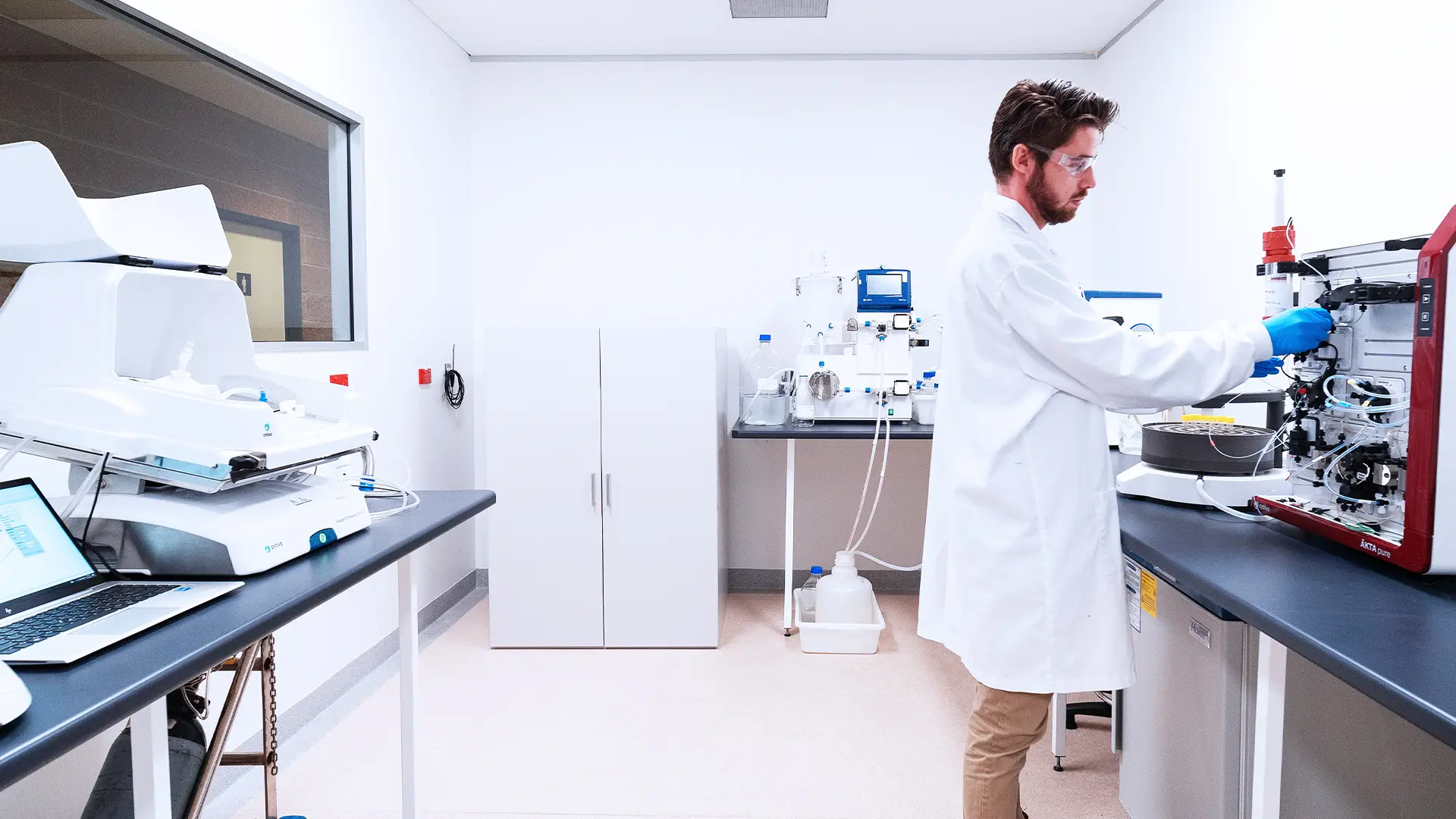
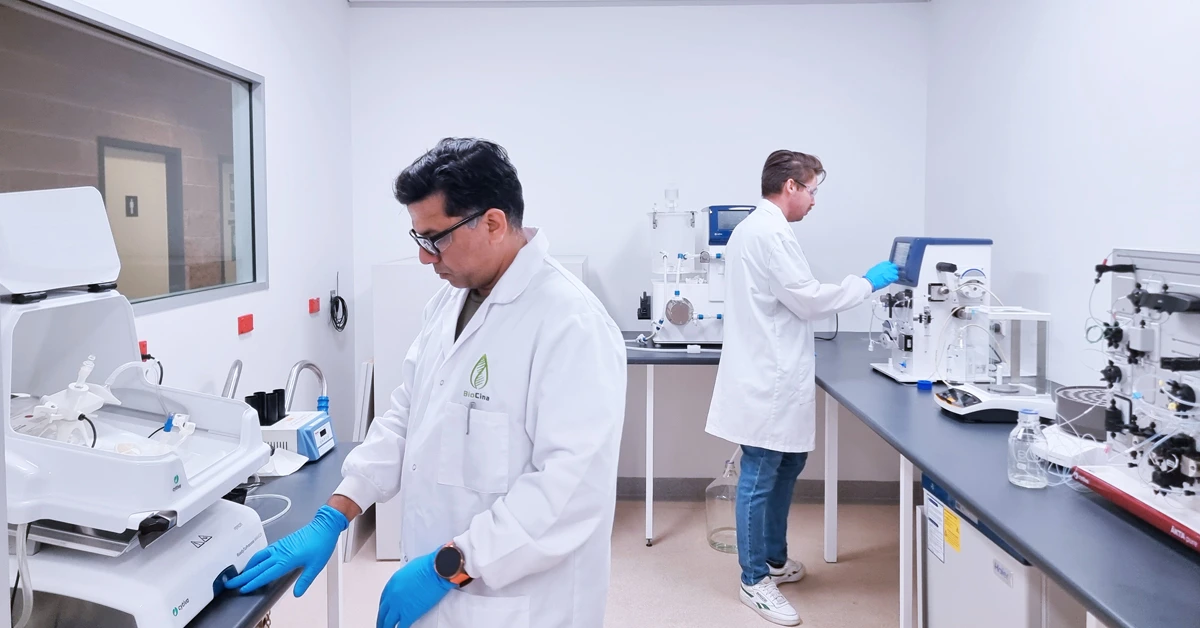
BioCina has an integrated mRNA drug substance platform within its dedicated Adelaide Nucleic Acid Suite, bringing plasmid DNA template supply, mRNA synthesis, downstream purification, and LNP formulation and encapsulation together under one quality management system, part of the same quality framework supporting cGMP biologics manufacturing at Adelaide. mRNA process development capabilities are established, and GMP liposome manufacturing has been demonstrated.
Simplify Technology Transfer with an Integrated mRNA Supply Chain
mRNA programs commonly involve several manufacturing interfaces: plasmid DNA production, in vitro transcription (IVT), mRNA purification, LNP formulation, and drug product manufacturing. Working across multiple suppliers can add technology-transfer activity, material movement, separate quality-system interfaces, and the need to maintain process knowledge across organizations.
BioCina's integrated platform reduces these interfaces by manufacturing linearized pDNA template, synthesizing mRNA, and performing LNP formulation and encapsulation within the same Adelaide facility. This can reduce inter-site technology transfer and associated process and analytical bridging activities as programs progress. The platform also connects to BioCina's sterile fill-finish operations in Perth, providing a single-company pathway from nucleic acid manufacturing through to finished drug product operations in Perth, providing a single-company pathway from nucleic acid manufacturing through to finished drug product.
In Vitro Transcription, Capping, and Downstream Purification
IVT mRNA manufacturing begins with in vitro transcription (IVT), a cell-free enzymatic process generating the target mRNA transcript from a linearized DNA template, using RNA polymerase, nucleotide triphosphates, and other reaction components. [2] BioCina's platform is capping technology agnostic, with cap structure selection based on program requirements and IP strategy.
Downstream, BioCina's mRNA purification train addresses process-related impurities through nuclease treatment, purification steps for residual DNA template and dsRNA clearance, and tangential flow filtration for concentration and buffer exchange. dsRNA is a key process-related impurity in IVT-based mRNA manufacturing, capable of activating innate immune pathways when not adequately controlled and removed. [3] BioCina works with client-defined sequences and supports construct and process optimization based on program requirements.
Scalable LNP Formulation and Encapsulation
For programs requiring LNP delivery, BioCina's mRNA LNP manufacturing platform uses Cytiva NanoAssemblr technology at process development, NanoAssemblr Spark, Ignite, and Blaze, and will extend to cGMP manufacturing on the NanoAssemblr Commercial Formulation System. LNP encapsulation takes place through controlled microfluidic mixing of the lipid and mRNA-containing phases, forming the nanoparticle around the mRNA payload. The NanoAssemblr Ignite and Blaze platforms and the Commercial Formulation System use the same underlying NxGen mixing architecture, supporting continuity in the underlying mixing mechanism and helping facilitate scale-up and process characterization as formulation moves toward larger manufacturing scale. [4] The cGMP production suite will support LNP pre-dilution volumes up to 600 L, depending on process and product requirements.
Scalable Equipment & Manufacturing Parameters
BioCina's platform spans mRNA process development through a new cGMP production suite, extending clinical mRNA manufacturing toward larger-scale supply. The same suite is designed to support commercial mRNA manufacturing as programs mature.
| Stage | Equipment | Working Volume | Yield |
|---|---|---|---|
| Process Development | WAVE 25 reactor; NanoAssemblr (Spark / Ignite / Blaze) | Up to 25 L; 20 microlitres to 1 L LNP pre-dilution | Up to 2 g formulated mRNA per batch (mass); up to 20+ L formulated product (volume) |
| cGMP Manufacturing | WAVE 25 reactor; NanoAssemblr (NCFS) | Up to 25 L; up to 600 L LNP pre-dilution | Up to 10 g formulated mRNA per sub-batch, up to 100 g per full batch (mass); up to 1,000+ L formulated product (volume) |
Keeping process development, IVT, capping, purification, LNP formulation and encapsulation within the same site supports continuity of process knowledge and reduces the need for inter-site tech transfer as programs progress toward GMP manufacture.
Quality Systems Built for Global Regulatory Requirements
BioCina's Adelaide site holds an active TGA manufacturing licence covering GMP mRNA manufacturing. This licence will be extended to cover non-sterile bulk drug product, bringing LNP-encapsulated mRNA formally within its scope. The Nucleic Acid Suite operates within the site's broader quality management system supporting cGMP mRNA manufacturing, physically separated from protein manufacturing areas, with a record free of critical GMP observations across inspections to date.
Australia's GMP framework is based on the PIC/S Guide to GMP, and the TGA adopts relevant international scientific guidelines while maintaining regulatory cooperation with major international authorities. [5] Quality systems and process design for the Nucleic Acid Suite are designed with relevant international regulatory expectations in mind, including FDA and EMA requirements where applicable.
mRNA analytical testing follows a phase-appropriate approach, with methods selected according to product, process, and development stage. [2] mRNA-specific characterization covers identity, content, integrity, and transcript size, capping efficiency, poly(A) tail length and distribution, residual DNA template, and dsRNA. Standard platform methods for endotoxin, bioburden, and pH are operational today. LNP-specific characterization, including particle size, particle size distribution (PDI), zeta potential, and encapsulation efficiency, supports formulated product testing. Where applicable, potency or functional activity assays are incorporated into the analytical strategy according to product and regulatory requirements. Analytical methods for mRNA-specific critical quality attributes continue to progress through development and qualification as the platform matures.
From Drug Substance Directly to Sterile Fill-Finish
The Adelaide platform will provide a pathway from mRNA synthesis and LNP formulation and encapsulation through to BioCina's sterile fill-finish operations in Perth. For sponsors seeking to reduce the number of manufacturing organizations involved in a program, this integrated structure simplifies coordination between drug substance and drug product manufacturing while supporting continuity of quality oversight and technical knowledge.
FAQs

Ready to Advance Your mRNA Program?
BioCina brings plasmid DNA template supply, mRNA synthesis, purification, and LNP formulation and encapsulation together within a dedicated Adelaide Nucleic Acid Suite, with a pathway to larger-scale GMP manufacturing and BioCina's sterile fill-finish operations in Perth.
Talk to Our Technical Team