
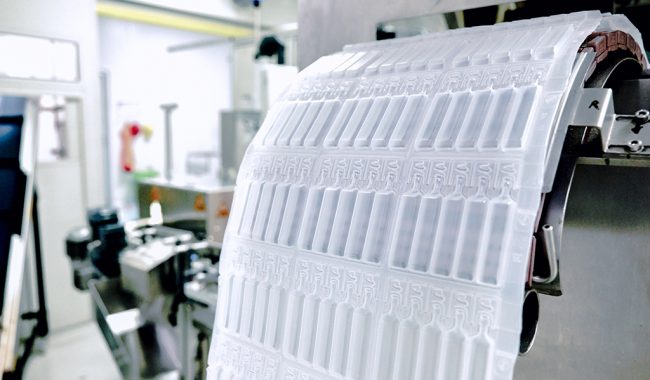
Blow fill seal technology is one of the fastest-growing segments in sterile pharmaceutical manufacturing. A single continuous automated process forms, fills, and hermetically seals plastic containers, eliminating open-air exposure at the critical fill point. As demand for preservative-free formulations, single-dose sterile liquids, and high-volume aseptic packaging accelerates, blow fill seal (BFS) technology is attracting sustained investment from pharmaceutical manufacturers, generic drug companies, and hospital supply chains worldwide, with contract BFS manufacturing partnerships increasingly the model of choice for commercial-scale sterile liquid programs.
What Is Blow Fill Seal Technology?
BFS is an advanced aseptic manufacturing technology that forms, fills, and hermetically seals a plastic container in one continuous automated process. Unlike conventional vial or glass ampoule filling, where the container arrives pre-formed and is exposed to the surrounding environment during filling, BFS creates the container from pharmaceutical-grade low-density polyethylene (LDPE) at the point of fill.
Because the container never exists as an open vessel, BFS delivers a higher inherent sterility assurance than conventional filling. Practical benefits for pharmaceutical manufacturers and patients include:
- Shatterproof, tamper-proof containers with no glass breakage or particulate risk
- Preservative-free single-dose or multi-dose options
- Hermetically sealed with 100% inline leak testing
- Freezable container formats for cold chain programs
- High-volume output at lower per-unit cost than glass ampoule lines
Five Reasons BFS Demand Is Accelerating
1. Preservative-Free Formulation Trends
Regulatory agencies and clinicians increasingly require preservative-free formulations, particularly for ophthalmic, inhalation, and injectable medications. BFS enables preservative-free single-dose presentations at commercial scale, making it the natural manufacturing platform for this growing segment.
2. Growth in Ophthalmic and Respiratory Therapy Manufacturing
Ophthalmic drops and respiratory inhalation solutions are the largest application categories for BFS. Rising chronic respiratory disease burden, age-related eye disease, and expanded access programs in emerging markets are driving sustained volume growth for these product types globally.
3. Hospital Shift to Ready-to-Use Packaging
Hospitals and healthcare systems are transitioning to ready-to-use injectable and irrigation packaging to reduce preparation errors and minimize contamination risk in clinical settings. BFS-formatted products satisfy this requirement without requiring in-hospital compounding.
4. Tightening Regulatory Standards for Sterile Packaging
The 2022 revision of EU Annex 1 raised expectations for contamination control across sterile pharmaceutical manufacturing. BFS technology, with its inherently closed forming and filling process, aligns naturally with these evolving standards.
5. Sustained Single-Dose Adoption Post-COVID-19
The COVID-19 pandemic accelerated industry preference for single-dose formats across sterile liquid categories, reducing cross-contamination risk and simplifying administration. This structural shift has created lasting downstream demand for BFS manufacturing capacity.
Market Growth: Key Figures
Independent market research consistently identifies BFS technology as a high-growth segment within pharmaceutical packaging CDMO evaluating capacity investment. While valuations vary by scope, the directional consensus is consistent:
- The global BFS technology market was valued at approximately USD 3.2 to 3.8 billion in 2025 across major research organizations
- Projected compound annual growth rates range from 6% to 10% through 2032 to 2035, depending on the research scope
- Asia-Pacific is the fastest-growing region for new BFS installations, driven by pharmaceutical manufacturing expansion in China, India, and Southeast Asia
- Pharmaceuticals represent approximately 75% of the BFS market by application, led by ophthalmic and injectable sub-segments
- Over 12 billion BFS-packaged pharmaceuticals were produced globally in 2024, reflecting continued acceleration in single-dose sterile liquid output
BFS Applications in Pharmaceutical Manufacturing
Blow fill seal technology is deployed across a broad range of sterile liquid manufacturing categories. BioCina’s platform spans all four major segments across 40+ validated presentations:
| Application | Common Product Types |
|---|---|
| Ophthalmic | Eye drops, single-dose preservative-free preparations |
| Inhalation | Nebuliser solutions, respiratory inhalation liquids (1 to 2.5 mL) |
| Irrigation | Wound irrigation, surgical flush solutions (up to 30 mL) |
| Sterile injectables | Small-volume injectables, electrolyte solutions |
| Vaccine diluents | Reconstitution liquids, vaccine vehicle solutions |
| Headspace O2 | Less than 5% achievable |
What to Look for in a BFS Manufacturing Partner
Not all BFS CDMO partners offer equivalent capability. The technology is highly specialized and the right partner selection comes down to four practical considerations.
The first is capacity and scheduling reliability. High-volume blow fill seal manufacturing services require a partner with substantial annual unit output operating 24×7 shifts, with enough throughput reserve to absorb commercial-scale demand without compromising supply schedules.
The second is format breadth. A partner supporting ophthalmic, inhalation, irrigation, and injectable head-mold formats within a single qualified site reduces the client qualification burden and simplifies supply chain management across a sterile liquid portfolio.
The third is regulatory approval depth. Products targeting the US, Europe, and Asia-Pacific markets simultaneously require FDA, EMA, and TGA approval of the manufacturing site. Single-site multi-jurisdictional approval eliminates the complexity of managing multiple CMC packages and supply relationships.
The fourth is operational track record. BFS is a specialized technology, and decades of continuous operation build the institutional knowledge, process discipline, and regulatory inspection history that newer platforms cannot replicate. As an established aseptic fill-finish CDMO, BioCina has operated BFS manufacturing for over 30 years, with 200M+ unit annual capacity, 40+ validated presentations, and approvals including EMA and TGA, supported by integrated formulation development and analytical services.
FAQs
What is BFS packaging in pharmaceuticals?
BFS packaging is a type of aseptic primary packaging in which a plastic container, typically low-density polyethylene (LDPE), is blow-formed, filled, and hermetically sealed in one continuous automated process, significantly limiting open-air exposure at the critical fill point. In shuttle-type machines, HEPA-filtered Grade A air protects the fill zone during the brief fill cycle. This is the sterility assurance advantage of BFS over conventional glass vial or ampoule filling, where the container arrives pre-formed and is exposed to the surrounding environment during the fill step.
What products use blow fill seal technology?
BFS technology is most commonly used for ophthalmic solutions, respiratory inhalation liquids, surgical and wound irrigation fluids, sterile injectable diluents, and single-dose vaccine diluents. It is particularly suited to preservative-free formulations and high-volume hospital supply products.
Is BFS technology suitable for biologics?
BFS is primarily used for small molecule sterile liquids and has been most widely validated for ophthalmic, inhalation, and injectable diluent categories. Biologic drug products, due to their molecular complexity and sensitivity to process conditions, are more commonly filled via aseptic vial filling or isolator-based platforms. For specific biologic programs, feasibility assessment with a qualified development team is recommended.
How does BFS compare to glass ampoule filling?
BFS offers several practical advantages over traditional glass ampoule filling: the plastic LDPE container is shatterproof and eliminates glass particle contamination risk; the enclosed forming and filling process provides higher sterility assurance than open-vessel filling; single-dose presentations reduce dosing errors; and at commercial scale, BFS typically delivers higher throughput and lower per-unit cost than glass ampoule lines.
BioCina's BFS Manufacturing Platform
BioCina has led Blow-Fill-Seal manufacturing for over 30 years, with 200M+ unit annual capacity across 40+ presentations. Fill volumes from 1 to 30 mL; batch sizes from 105 L to 25,000 L. Multi-jurisdictional approvals include FDA, EMA, and TGA. To discuss your program, contact BioCina.
SME VERIFICATION REQUIRED | EU ANNEX 1 STATUS: SME confirmed that currently only 1 BFS line is Annex 1 compliant; a second line (BFS line 1) is expected to be compliant mid-2026. This claim has been intentionally excluded from the blog body to avoid overclaiming. Confirm the exact number of compliant lines at the point of publication and decide whether to include this detail in the CTA callout.
[1] Persistence Market Research. Blow Fill Seal Technology Market Size and Future Growth 2032. persistencemarketresearch.com, 2025.
[2] FactMR. Blow Fill Seal Technology Market Share and Statistics 2035. factmr.com, 2025.
[3] Market Growth Reports. Blow Fill Seal Technology Market Size. marketgrowthreports.com, 2024.
[4] European Commission. Annex 1 to EU Guidelines for Good Manufacturing Practice: Manufacture of Sterile Medicinal Products. EudraLex Volume 4, August 2022.
[5] Future Market Insights. Blow Fill Seal Technology Market: Global Market Analysis Report 2035. futuremarketinsights.com, April 2026.
Related pages: Blow-Fill-Seal Ampoules | Diluent Services | Discuss Your BFS Program